
For industrial machinery, automated doors, material-handling equipment, and other moving systems, a safety contact strip is more than a flexible protective component. It is a pressure-sensitive safety device that can detect contact along a protected edge and provide an input to the machine’s safety control system.
For US industrial buyers, the challenge is not simply finding a safety contact strip that fits a machine. The more important task is selecting a configuration that matches the machine’s movement, available installation space, required trigger characteristics, environmental conditions, and control architecture.
Rather than choosing a product based only on brand recognition or price, OEMs, system integrators, distributors, and machinery manufacturers can evaluate safety contact strips according to several practical engineering factors.
What Is a Safety Contact Strip?
A safety contact strip, commonly associated with a Safety Edge or pressure-sensitive safety edge, is designed to respond when pressure is applied to its sensing surface. It can be installed along the leading or exposed edge of moving equipment where physical contact needs to be detected.
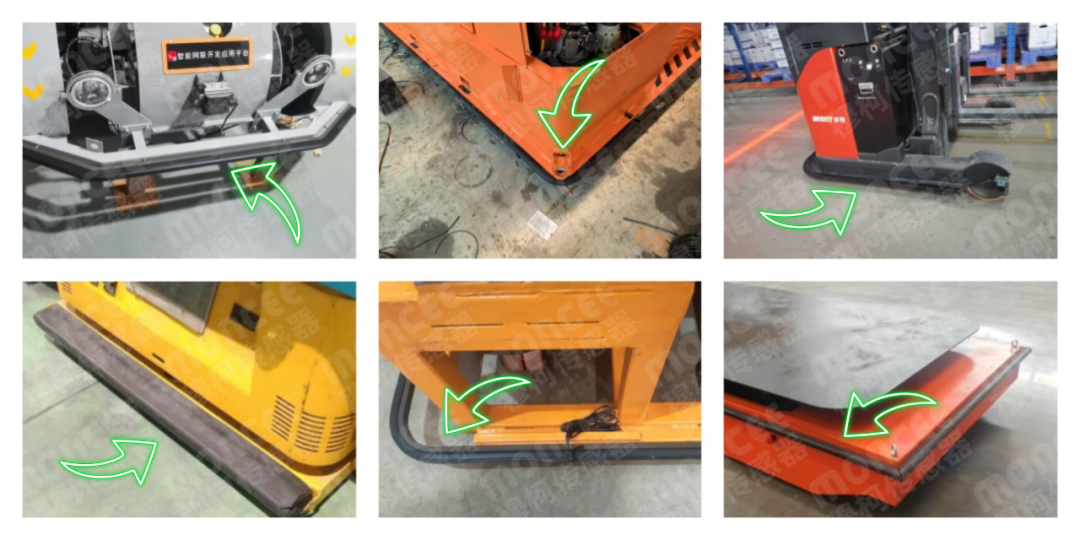
Typical applications include industrial doors, automated machinery, machine covers, material-handling equipment, and other moving structures. The manufacturer’s published product information also highlights applications such as automotive manufacturing, white-goods production, textiles, packaging, stamping and forging, and non-standard automation.
The sensing strip is normally integrated with a suitable control circuit so that a detected contact can initiate an appropriate machine response. The complete application should be engineered and validated according to the machine’s risk assessment and control design.
Why Profile Selection Matters
One of the first purchasing decisions is the physical profile.
A safety contact strip must fit the available mounting space while providing sufficient sensing coverage for the protected edge. Different profile shapes can provide different mechanical characteristics, including different trigger distances and force levels. The manufacturer specifically identifies profile variation as a way to accommodate different trigger distances and force requirements.
For OEM projects, this makes mechanical compatibility an important part of product selection. Engineers should consider:
Available mounting space
Protected edge length
Direction of movement
Contact location
Required deformation area
Mounting method
Connection and cable routing
Selecting the profile at the beginning of the machine-design process can reduce modifications during final assembly.
Trigger Force Should Match the Application
Trigger Force describes the force required to activate the safety contact strip. It should not be treated as an isolated specification.
The actual force response can depend on the object making contact, its speed, the location of contact, and the amount of profile deformation. Rockwell Automation's safety-edge documentation likewise explains that force depends on the shape and speed of the object and the deformation distance of the profile.
For this reason, engineers should evaluate how contact is expected to occur during normal and abnormal machine operation. A configuration suitable for a slow-moving door may not necessarily be appropriate for a faster automated mechanism.
The objective is to select a safety contact strip whose mechanical response corresponds to the machine's actual operating conditions.
Trigger Distance and Overtravel Are Equally Important
Another important parameter is Trigger Distance—the amount of deformation or travel associated with activation of the sensing function.
For moving machinery, Trigger Distance should be considered together with stopping distance and available overtravel. After a contact is detected, the safety control system still needs to process the signal and the machine needs to decelerate or stop.
This means the engineering sequence should be considered as a complete system:
Contact → Safety Contact Strip → Control Signal → Machine Response → Stopping Travel
Safety-edge guidance emphasizes evaluating the stopping travel and ensuring that the selected device provides sufficient overtravel for the application.
This is particularly important for OEMs designing equipment with significant moving mass, higher operating speeds, or limited stopping space.
Mechanical Integration Can Improve Installation Efficiency
A commercially useful safety contact strip should not only perform its sensing function; it should also be practical to install.
The mounting arrangement needs to hold the strip securely along the protected edge while allowing the sensing surface to remain correctly positioned. A compatible support profile can simplify installation and help create a more consistent finished assembly.
For machine manufacturers producing multiple units, installation efficiency becomes especially important. A well-defined mounting configuration can reduce assembly variation, simplify production instructions, and make replacement easier during maintenance.
Cable Configuration Should Be Defined Early
Electrical connection is another consideration that is sometimes left until the end of a machine project.
The cable or lead-out arrangement should correspond to the physical structure of the equipment and the location of the safety controller. Depending on the machine architecture, the safety contact strip may be integrated with a suitable safety relay or safety PLC.
Published industrial safety-edge products demonstrate this type of control integration, including connection to safety relays or safety PLCs.
For OEM applications, specifying cable direction, lead-out position, and connection requirements early can make machine assembly cleaner and reduce unnecessary routing changes.
Consider the Operating Environment
Industrial equipment can operate in very different conditions. A safety contact strip installed on an indoor automated machine may face very different environmental demands from one installed on an industrial door or outdoor material-handling system.
When selecting a product, purchasing and engineering teams should consider:
Operating temperature
Moisture exposure
Dust and contamination
Chemical exposure
Mechanical abrasion
Indoor or outdoor installation
Cleaning and maintenance procedures
Material selection should therefore be linked to the actual operating environment rather than treated as a generic product feature.
Custom Lengths Benefit OEM Production
For machinery manufacturers, standard lengths are not always sufficient.
A custom-length safety contact strip can be valuable when the protected edge has a non-standard dimension. Instead of adapting the machine around an off-the-shelf component, the OEM can specify the required sensing length and configuration according to the equipment design.
This approach can be particularly useful for automated machinery, large doors, specialized production equipment, and customized material-handling systems.
It can also simplify procurement by reducing unnecessary joints or multiple short sections in a single protected area.
Why Work Directly With a Manufacturer?
For commercial buyers, direct communication with a manufacturer can be valuable when the application requires more than a standard catalog configuration.
Project discussions can cover profile geometry, dimensions, sensing length, Trigger Force, Trigger Distance, cable arrangement, mounting requirements, and operating environment.
The manufacturer’s published information specifically emphasizes multiple profile shapes and the importance of selecting the appropriate model according to Trigger Distance and contact force.
For OEMs and system integrators, this application-oriented approach can make product development more efficient and provide greater flexibility for customized machinery.
How to Select the Right Safety Contact Strip
Before requesting samples or a quotation, industrial buyers should prepare several key details:
Machine or equipment type
Length of the protected edge
Available mounting dimensions
Direction and speed of movement
Estimated stopping distance
Required Trigger Force and Trigger Distance
Cable and connection requirements
Operating environment
Mounting method
Expected production or purchasing volume
Providing these details allows a manufacturer to evaluate the application more accurately and recommend an appropriate configuration.
Conclusion
The right safety contact strip should be selected according to the complete machine application—not simply according to price, appearance, or a generic product description.
Profile geometry, Trigger Force, Trigger Distance, overtravel, mounting, cable configuration, environmental conditions, and customization requirements all influence how effectively a Safety Edge can be integrated into industrial equipment.
For US OEMs, system integrators, automation companies, machinery manufacturers, and distributors, an application-focused supplier can provide greater flexibility when standard configurations do not fully match the project.
If you are sourcing safety contact strips for industrial machinery, provide your machine drawings, protected-edge dimensions, mounting requirements, movement characteristics, environmental conditions, and wiring requirements. These details provide a practical starting point for selecting the appropriate Safety Edge configuration and requesting samples or a commercial quotation.



 English
 简体中文
 Indonesian
 Previous:
 Back to list


