
What type of signal output does the safety edge (touch edge) provide?
It provides a normally open (NO) dry contact switch signal output, which is passive and requires no separate power supply. It is recommended to connect it in series into a DC24V circuit.
The circuit is open when not pressed.
The circuit closes when pressed.
Do you offer a normally closed (NC) version? I prefer NC for higher safety.
Yes, we offer a normally closed (NC) safety edge with one NC contact.
Alternatively, you can also use a normally open (NO) safety edge together with a safety controller, which provides additional safety features:
A. Detects both wire breakage and actuation (stepping/pressing), triggering alarms.
B. Monitors the operational status of the safety edge and indicates abnormal conditions via LED indicators on the controller.
C. Converts the input signal into two NC outputs and one NO output.
D. When used together, the safety edge and controller achieve SIL3 / PL e (Category 3) safety performance levels.
My application environment involves water—will that be an issue?
Our safety edges are rated IP65, meaning they can withstand low-pressure water jets from any direction (approximately 0.3 MPa pressure, 12.5 L/min flow rate) without damage.
I’m equipping an AGV cart with a safety edge—can you help select a model?
We need to confirm whether bending/flexing is required. If yes, please provide either a bending diagram or a CAD drawing of your AGV’s outer dimensions.
You mentioned: “The drawing has been sent—please review.”
Based on your drawing, your minimum bend radius is 50 mm. We recommend model SYD-A508, which supports a minimum bend radius of 50 mm and meets your requirement. We’ll send you an updated CAD drawing shortly for confirmation.
Additionally, please review our installation case studies to verify compatibility. Given your condition that the curvature radius exceeds 205 mm, we also recommend model SYD-A431-L. This model was specifically developed for tire industry applications (e.g., vulcanizing and forming machines). It comes with a mounting bracket that allows quick press-fit installation and is especially suitable for bent-edge scenarios.
Why can’t the normally closed (NC) safety edge be bent?
The NC version uses a mechanical reed switch inside. When external force is applied, the internal elastic element stretches or contracts, causing the contacts within the switch core to either disconnect (open) or connect (close), thereby switching the circuit state.
Due to this mechanical principle, bending the edge would unintentionally trigger actuation, leading to false signals or malfunction. Therefore, NC-type safety edges must remain straight and cannot be bent.
Can you drill holes for us?
Yes. Our factory is equipped with dedicated hole-drilling machinery. Just provide your drawing, and we’ll drill holes precisely according to your specifications.
Please tap threads for me.
Certainly—we can perform thread tapping as per your requirements. Please specify the thread standard (e.g., M4, M5, etc.) and location on your drawing.
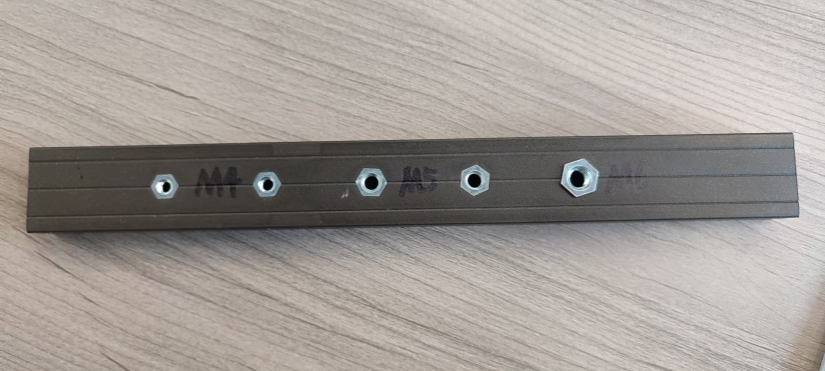
The safety edge mounting bracket is only 2 mm thick, which is too thin for tapping threads. Instead, we will use rivet nuts (as shown in the figure) to ensure a secure and robust installation.
8. I bought a safety edge that’s too long—can I cut it myself?
Cutting is not recommended unless absolutely necessary, as the product has already been treated for waterproofing and dust protection, and improper cutting may shorten its service life.
If cutting is unavoidable, please follow these steps:
Use scissors to trim to the desired length;
Wrap the internal conductive rubber with waterproof tape;
Seal the outer end with a dedicated end cap and adhesive.
9. What are your pre-sales advantages, and why are your products more expensive than others?
As an original manufacturer, our key advantages include:
Full customization of safety edge cross-sections, lengths, and bending profiles;
Both our safety edges and controllers carry CE certification, with complete compliance documentation;
Comprehensive support materials—including product catalogs, user manuals, and installation videos;
Our internal conductive rubber has a resistance of only 20 ohms (industry average is 90–100 ohms), enabling faster signal response and enhanced safety—ideal for AGVs, tire vulcanizers, and other demanding applications.
While lower-priced options may seem attractive, the price difference often reflects compromises in quality and service. We maintain our pricing to ensure reasonable margins that allow us to guarantee project safety, on-time delivery, and peace of mind for our customers.
10. Is it easy to install? Do you offer on-site installation?
We do not provide on-site installation services, but installation is straightforward:
Simply mount the bracket by drilling holes and securing it to your equipment with screws;
Apply diluted hand soap or dishwashing liquid to the mounting surface;
Slide the safety edge strip into place.
11. Are safety edges prone to failure? If it breaks, can I contact you directly?
We are a major domestic manufacturer, and our safety edges come with a 1-year warranty. Non-human-induced defects are covered by free repair or replacement.
For any post-purchase issues, feel free to contact us directly. Our professional technicians respond quickly—minor issues can even be resolved via real-time video guidance, saving you time and money.
12. Which well-known factories commonly use your products?
AGV/Mobile Cart Manufacturers:
BYD
Foxconn
Zeekr Auto
Foshan Guanghua
Siasun Robot (Wuhan)
Machine Tool Builders:
Yeong Chin Machinery (Youjia International CNC)
Jinan No.2 Machine Tool Group
Kunshan Xin Heng Chang Machinery



 English
 简体中文
简体中文 Indonesian


