
In modern manufacturing environments, floor-level hazards can be difficult to control with conventional guarding alone. Operators may need to work close to machinery, enter loading areas, or move through zones where physical barriers are impractical. In these situations, an Industrial Safety Mat can provide an additional layer of machine safety by detecting the presence of a person in a defined hazardous area and sending a signal to the machine safety circuit.
For OEM machine builders, automation integrators, distributors, and industrial procurement teams, however, purchasing a safety mat is not simply a matter of selecting a standard size. Material, load capacity, environmental protection, dimensions, controller compatibility, customization capability, and supply stability all affect the suitability of the final solution.
This article explains what businesses should consider when sourcing Industrial Safety Mat products for OEM projects, custom applications, and bulk purchasing.
What Is an Industrial Safety Mat?
An Industrial Safety Mat is a pressure-sensitive safety device installed on the floor around machinery or other hazardous areas. When sufficient pressure is applied to the sensing surface, the mat generates a switching signal. When connected to a suitable safety mat controller, this signal can be incorporated into the machine's safety circuit.
Unlike a conventional floor covering, an industrial safety mat is designed specifically for safety-related applications. It can create a monitored protection zone around equipment such as industrial robots, automated machinery, assembly systems, stamping equipment, and material-handling equipment.
The Moncee SC4 series includes several safety mat configurations designed for different industrial environments, including standard, high-performance, waterproof, forklift, car-wash, seat, and armored applications.
Why OEM Buyers Need More Than an Off-the-Shelf Product
For machine manufacturers, the safety mat is often only one component of a complete machine safety architecture. A product that works for one application may not be suitable for another because operating conditions can vary significantly.
For example, an OEM project may require:
A specific mat length and width
Different surface or structural materials
Higher mechanical durability
Resistance to oil or other industrial contaminants
Waterproof construction
Special cable outlet positions
Multiple mats connected to one safety system
Compatibility with a dedicated safety mat controller
Stable specifications across repeated production batches
This is why custom manufacturing capability can be more valuable than simply having a large catalog of standard products.
A supplier should be able to understand the machine layout, operating environment, expected loads, installation conditions, and required safety interface before recommending a configuration.
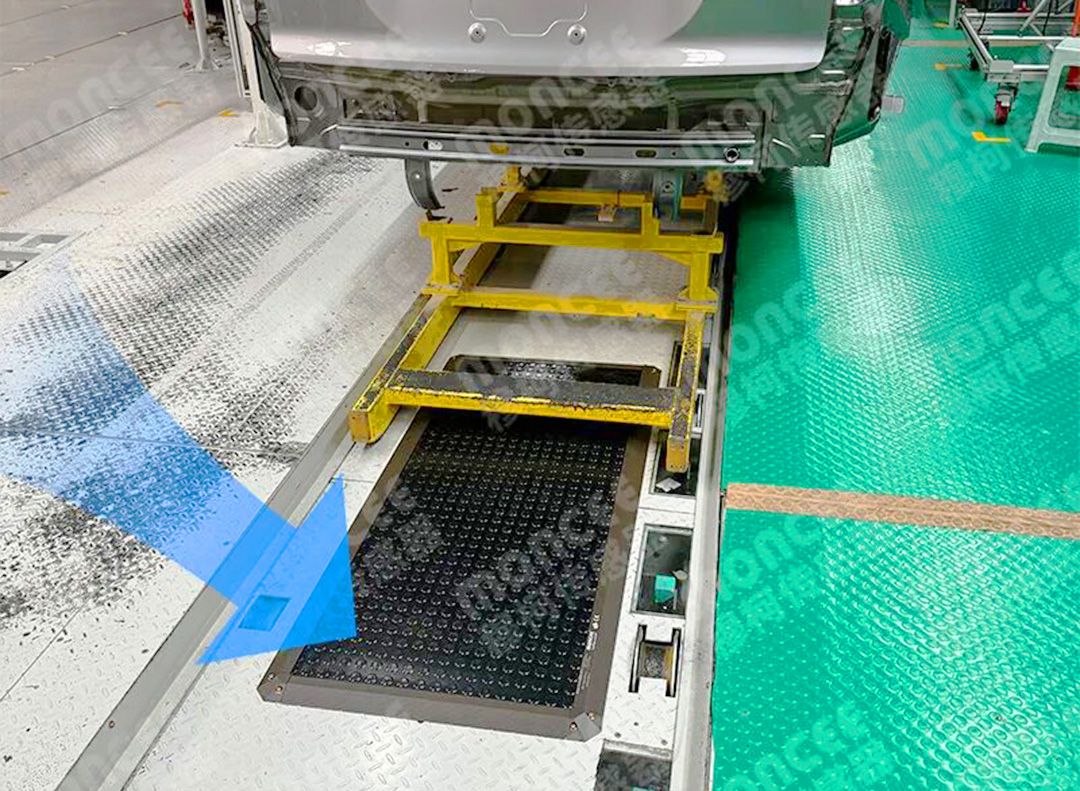
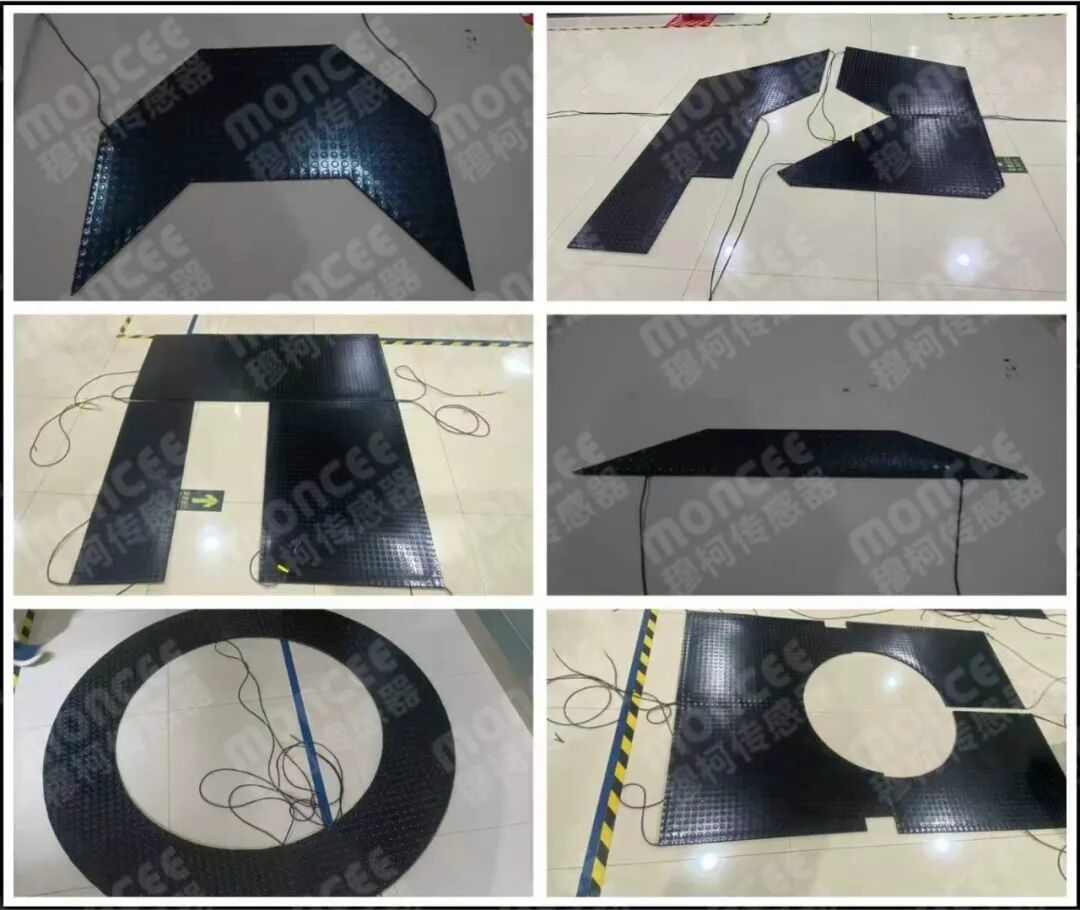
Custom Industrial Safety Mat Manufacturing
Customization is particularly important for OEMs and system integrators because machines rarely have identical floor layouts.
The SC4 product family supports multiple standard dimensions, while customized dimensions can be considered for specific applications. Different edge structures and cable configurations are also available depending on the product design.
For a custom project, buyers should provide the supplier with at least the following information:
Protection area – Define the hazardous zone that needs to be monitored.
Required dimensions – Confirm the length and width of each mat.
Expected loading – Consider both operator loading and equipment or wheel loading.
Working environment – Identify exposure to water, oil, chemicals, dust, heat, or mechanical abrasion.
Installation method – Check floor conditions, surrounding structures, and edge requirements.
Electrical interface – Confirm controller, wiring, and machine safety-circuit requirements.
Quantity and production schedule – Important for OEM quotation and capacity planning.
Providing this information at the quotation stage helps reduce repeated engineering communication and minimizes the risk of ordering a product that later requires modification.
Material Selection for Different Industrial Environments
Industrial Safety Mat performance is closely related to its construction and material.
The Moncee catalog includes different material configurations, including rubber-based constructions, EPDM/EPM, PUR environmental materials. Different versions are intended for different operating requirements.
Therefore, procurement teams should avoid choosing a material based only on price. The correct question is whether the material and construction match the actual working environment.
IP65 vs. IP67: An Important Procurement Detail
Protection rating is another specification that should be checked carefully rather than treated as a generic product feature.
For Moncee's Industrial Safety Mat range:
Standard Safety Mat: documented at IP65
Waterproof Safety Mat: specified at IP67
This distinction is important when preparing OEM specifications or technical purchasing documents. A standard model should not automatically be described as IP67 simply because waterproof models in the same product family achieve IP67.
For applications involving regular washing, water exposure, or demanding cleaning conditions, buyers should specifically request the appropriate waterproof model rather than assuming that every safety mat configuration provides the same protection level.
Safety Mat Controller and System Integration
An Industrial Safety Mat normally works as part of a safety system rather than operating as an isolated component.
The Moncee catalog provides dedicated safety mat controllers designed to monitor the mat circuit and interface with machine safety control systems. The controller configuration includes dual-channel monitoring and safety relay outputs, with indicator functions for system status.
For OEM applications, the controller should be evaluated together with the mat. Important considerations include:
Supply voltage
Safety output configuration
Wiring method
Number of mats supported
Reset requirements
Response time
Compatibility with the machine's safety circuit
The catalog describes a DC24V controller configuration with safety relay outputs and a controller response time of up to 20 ms. The safety mat itself is specified with a response time of up to 30 ms for relevant models.
Exact system performance should always be evaluated according to the selected mat, controller, wiring arrangement, and machine safety architecture.
Bulk Purchasing: What Should Buyers Evaluate?
For distributors and high-volume OEM customers, unit price is only one part of the purchasing decision.
A more useful evaluation includes the total procurement cost, which may include:
Product price
Controller cost
Custom tooling or engineering requirements
Packaging
Shipping
Replacement inventory
Quality inspection
Lead time
After-sales technical support
Consistency is equally important. When a machine manufacturer orders hundreds or thousands of safety mats over multiple production cycles, uncontrolled specification changes can create engineering and inventory problems.
A reliable supplier should therefore provide stable technical documentation, consistent product specifications, clear model identification, and repeatable production quality.
Choosing an Industrial Safety Mat Supplier
When selecting an Industrial Safety Mat manufacturer or OEM supplier, businesses should evaluate the supplier from both technical and commercial perspectives.
A strong supplier should be able to provide:
Technical capability:
Ability to recommend suitable materials, dimensions, structures, and controller configurations.
Customization capability:
Support for project-specific dimensions, cable arrangements, edge structures, and specialized models.
Application experience:
Knowledge of robotics, automation, material handling, stamping, assembly, doors, and other industrial applications.
Quality and documentation:
Clear specifications, technical drawings, test information, and product identification.
Production capacity:
The ability to maintain stable quality and delivery schedules for recurring bulk orders.
Long-term cooperation:
OEM customers need more than a one-time transaction. Engineering communication, replacement supply, and future product support can have a major impact on the total project cost.
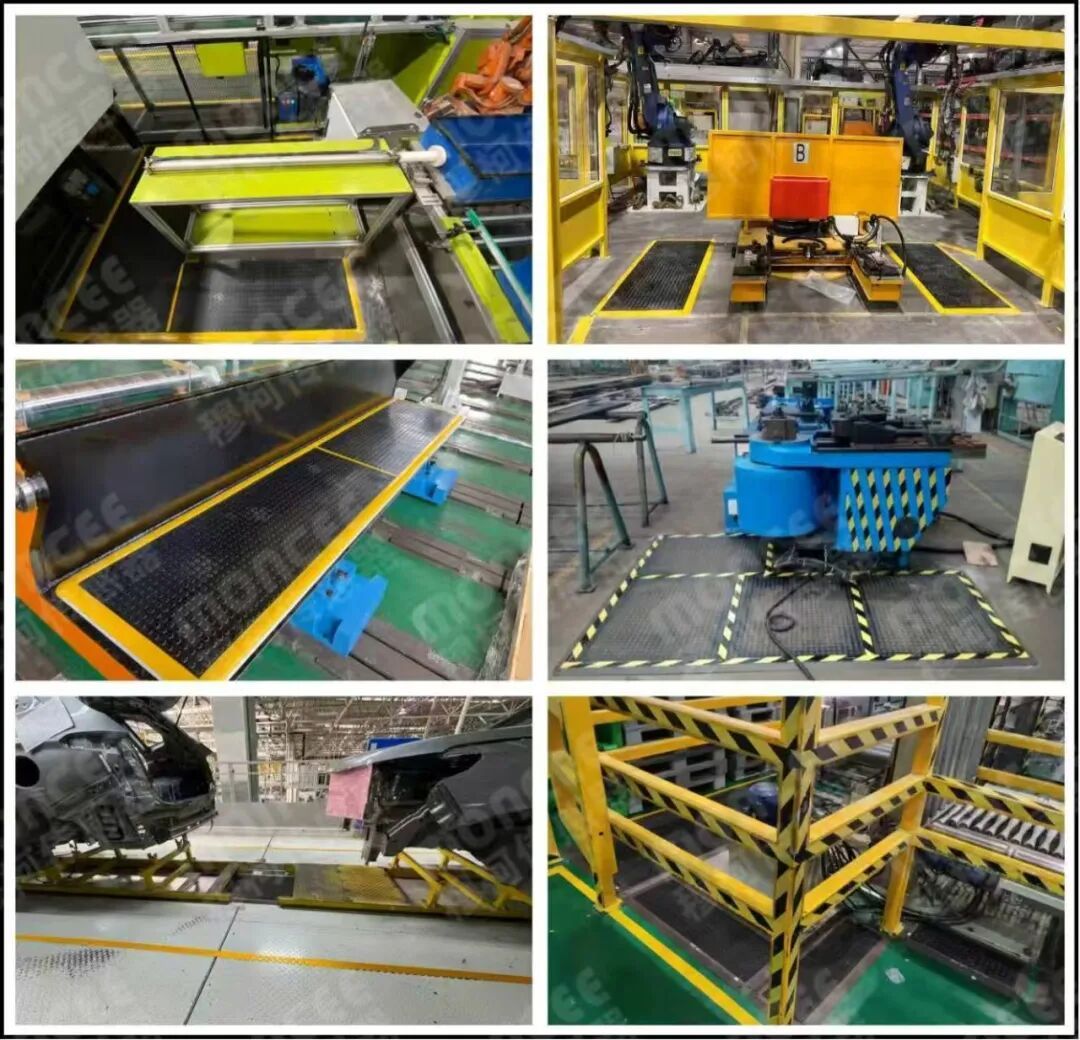
Industrial Safety Mat Solutions for OEM and Bulk Projects
An Industrial Safety Mat becomes much more valuable when it is treated as part of an engineered safety solution rather than simply a purchased component.
For OEM machine builders, the ideal sourcing process starts with the application and works backward toward the product specification. For distributors, product variety and stable supply are critical. For automation integrators, compatibility between the mat, controller, and machine safety system is a key consideration.
Moncee's SC4 safety mat portfolio covers multiple industrial configurations, including standard, high-performance, waterproof, forklift, car-wash, seat, and armored safety mats. This product diversity provides a foundation for addressing different industrial requirements while allowing buyers to select a configuration based on the actual application.
For businesses purchasing Industrial Safety Mat products in volume, the best supplier is not necessarily the one offering the lowest initial quotation. It is the supplier capable of combining appropriate product engineering, customization, stable quality, technical support, and dependable long-term supply.
That approach can help OEMs and industrial distributors reduce sourcing risk while building a more consistent safety solution for their customers.



 English
 简体中文
简体中文 Indonesian
 Previous:
 Back to list


