
In wide-web film stretching facilities producing materials such as BOPET and BOPP, production lines can extend for dozens of meters and incorporate numerous moving roller assemblies, width-adjustment mechanisms, and movable maintenance doors. Routine operations—including inspecting film surface quality, removing edge trim, changing rolls, and performing emergency equipment repairs—require operators to work close to moving machinery.
Many factories use safety light curtains to protect hazardous areas. However, airborne film scraps, fluttering film-edge strips, and ambient dust commonly found in film production workshops can interfere with optical sensing and cause nuisance triggering. This can lead to frequent, unnecessary machine stoppages that directly affect production output, creating a persistent challenge for manufacturers.
Under these operating conditions, a contact-based protection solution combining safety edges and safety mats is increasingly being adopted for film stretching production lines. Each device serves a distinct purpose, working together to establish a personnel safety protection system better suited to the operating environment of the film industry—from hazardous machine edges to high-risk floor areas.
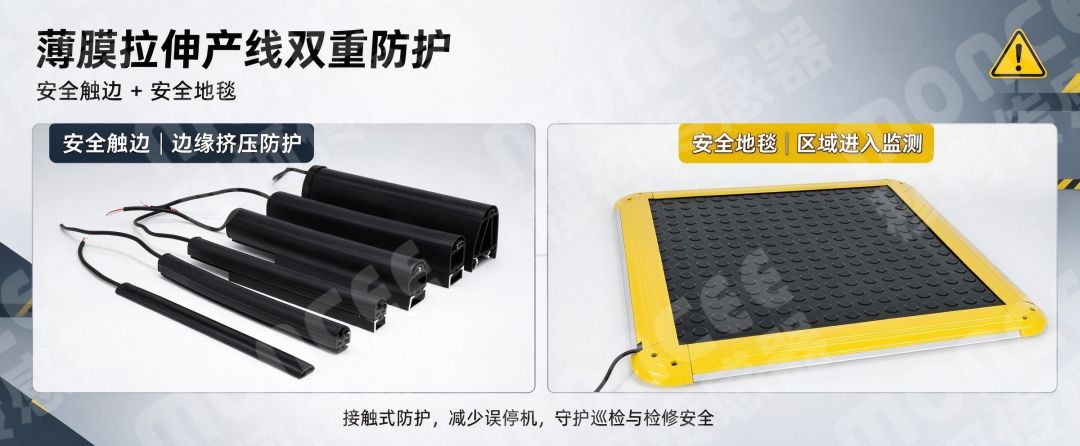
Safety Edges: Protecting Hazardous Machine Edges Against Crushing and Shearing Risks
Production-line safety guards, movable maintenance doors, and mobile machine frames can contain numerous pinch points and crushing hazards. Safety edges feature a flexible rubber construction and function as contact-sensitive safety devices mounted directly along the edges of hazardous machinery and equipment.
When an operator’s body or clothing accidentally comes into contact with, or compresses, the safety edge, the device immediately generates a safety signal. This signal is transmitted to the safety controller, which initiates the appropriate safety response to stop the hazardous motion of the production line. Pulling rollers and moving machine frames can then be brought to a stop, helping prevent crushing and entrapment injuries.
Why Safety Edges Are Suitable for Film Stretching Production Lines
Modular installation for extended protection: Multiple sections can be connected to accommodate the long protection distances required by film stretching lines, without extensive modifications to existing equipment.
IP65 ingress protection: Designed to withstand workshop dust and limited exposure to oil contamination, while avoiding nuisance triggering caused by fluttering film strips.
Flexible rubber construction: Accidental contact between film and the safety edge is less likely to scratch the film surface, helping protect finished-product quality from secondary damage.
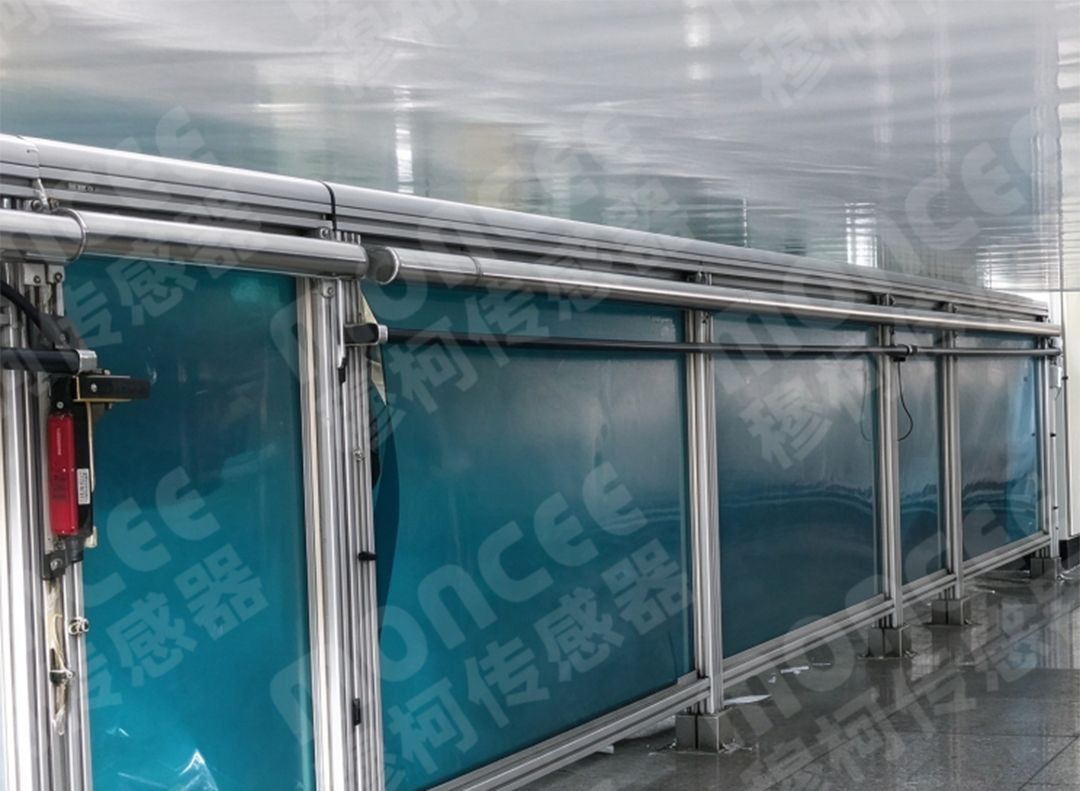
Flexible mounting options: Safety edges can be installed directly on aluminum-profile safety guards, movable maintenance-door frames, and mobile roller assemblies.
Typical installation locations:
Long safety-guard sections along production lines
Frames of movable maintenance doors
Moving roller frames used in film-width adjustment mechanisms
Edges of mechanisms presenting shearing hazards
Safety Mats: Floor-Level Area Detection to Prevent Unauthorized Entry into Hazardous Zones
Edge protection alone has a limitation: if an operator steps into a hazardous floor area in front of a machine without touching its protected edges, the safety edge will not be activated.
This is where safety mats provide an additional layer of area-based protection.
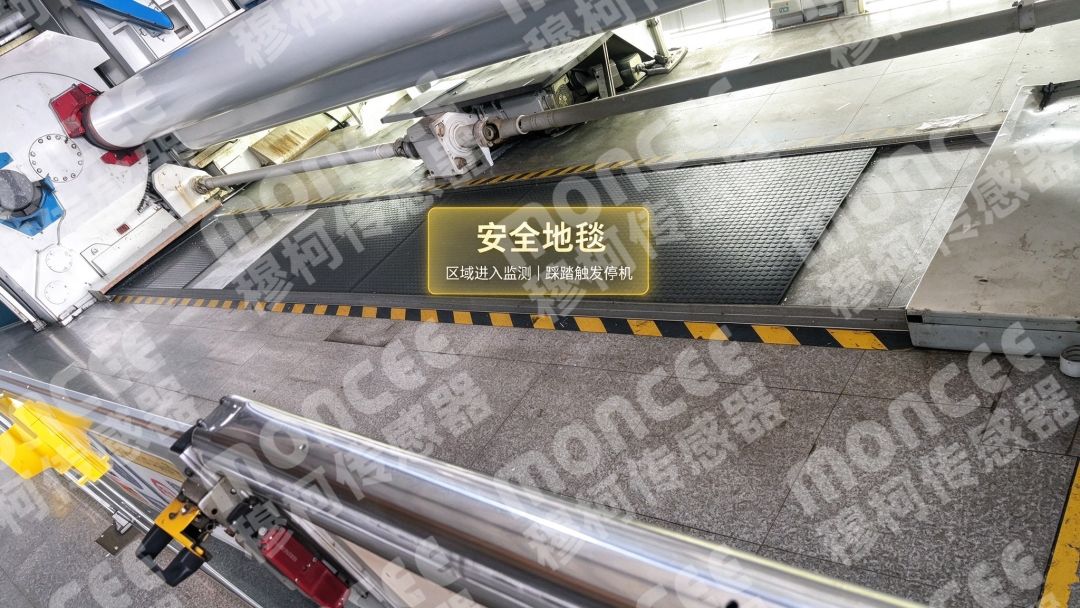
Safety mats are pressure-sensitive safety devices installed on the floor in hazardous areas. When a person steps onto the mat, the applied pressure triggers a safety signal that can initiate a machine safety stop. Rather than relying on physical collision with the equipment, the system responds to the operator’s presence through applied pressure—stopping hazardous machine motion when a person enters the protected area.
Why Safety Mats Are Suitable for Film Stretching Production Lines
Area-based protection: Provide coverage across a defined floor area, complementing the linear protection offered by safety edges.
Protection during close-proximity operations: Help initiate a safety stop when operators approach hazardous areas during roll changes, maintenance, and inspection.
Easy installation: Suitable for open floor areas in front of equipment, maintenance access routes, and other designated high-risk work zones.
Typical installation locations:
Maintenance access walkways
Roll-changing workstations
Openings in safety guards
High-risk floor areas directly in front of machinery
Important: Safety edges and safety mats are not alternatives to one another. They provide complementary forms of protection.
Safety edges protect hazardous machine boundaries; safety mats protect designated floor areas. Used together, they can provide a more comprehensive personnel protection system.
Practical Recommendations for Implementing Safety Protection on Production Lines
1. Plan Protection Points and Zones
Install safety edges on safety guards, movable doors, and moving mechanisms. Position safety mats at roll-changing stations and along maintenance access routes.
Connect all safety signals to an appropriate safety controller. Depending on the machine's risk assessment and safety requirements, configure the system to initiate zoned stopping or a full machine emergency stop.
2. Select Appropriate Products and Establish a Maintenance Routine
Choose industrial-grade safety mats with suitable wear and oil resistance.
Film-edge trim and scraps must not accumulate on or cover the mat surface. Perform basic cleaning at every shift to help maintain reliable operation and prevent obstruction or impaired device performance.
3. Integrate Devices into the Machine Safety Circuit
Safety edges and safety mats must be integrated into the machine's appropriate safety-related control system and stopping circuit. Audible or visual alarms alone do not provide an adequate substitute for a safety-related stopping function.
The complete system must be designed and validated according to the machine's risk assessment and applicable safety requirements.
4. Define the Protection Area Appropriately
Determine device placement through an on-site safety risk assessment.
It is not necessary to cover every part of the floor. Instead, prioritize high-risk areas and avoid unnecessary triggering that could cause excessive nuisance stoppages. The objective is to balance personnel safety with equipment availability and production efficiency.
Conclusion
Film stretching production lines have distinctive operating conditions. Fluttering film, loose scraps, and airborne particles can make the environment challenging for optical sensing devices.
Safety protection should therefore not rely solely on generic equipment standards. It must be designed around the actual operating conditions of the production floor.
Safety edges address crushing and shearing hazards along machine boundaries, while safety mats help detect personnel entering designated hazardous floor areas.
Together, these complementary protection devices offer an integrated approach to reducing personnel risks on film stretching production lines—helping address the long-standing challenge of balancing operational safety with production output and providing a more reliable safety barrier for frontline inspection, roll-changing, and maintenance personnel.



 English
 简体中文
 Indonesian
 Previous:
 Back to list


