
When evaluating a Machine guarding edge sensor, the lowest purchase price is not always the most economical choice. Industrial buyers must consider the sensor’s specifications, compatibility with existing control systems, mounting requirements, service life, and the labor needed to complete installation. A sensor that appears inexpensive on a quotation may create additional costs if it requires extensive modifications or frequent replacement.
For machine builders, automation integrators, equipment manufacturers, and industrial procurement teams, understanding these cost factors makes it easier to compare suppliers and select a practical solution. This guide explains what influences machine guarding edge sensor prices, which specifications deserve attention, and how to reduce installation expenses without compromising the intended safety function.
1. What Determines Machine Guarding Edge Sensor Prices?
There is no single price that applies to every machine guarding edge sensor. The final quotation depends on the design, quantity, customization requirements, and intended operating environment.
Sensor profile and dimensions
The profile determines how the sensor fits the protected edge and how it responds when contact occurs. Different profiles can accommodate different trigger distances and contact-force requirements.
A compact profile may suit a limited installation space, while a larger profile may be more appropriate for a different contact condition. Required length also affects material usage and manufacturing requirements.
Before requesting a quotation, provide the supplier with the required cross-section, overall length, mounting arrangement, and available installation space. This helps reduce the risk of ordering a product that needs modification after delivery.
Electrical configuration
Electrical compatibility is another important cost factor. Buyers should confirm whether the application requires a normally open (NO) or normally closed (NC) output and whether the selected sensor can interface with the intended controller or monitoring circuit.
A price comparison is meaningful only when the quoted products have compatible electrical characteristics. If the chosen sensor requires additional interface components, wiring changes, or control-system adjustments, the total project cost may increase.
Material and operating environment
The outer material should suit the equipment’s working conditions. Temperature, exposure to dust or moisture, mechanical wear, cleaning practices, and contact conditions can all influence product selection.
A lower-priced sensor may not represent good value if its construction is unsuitable for the application. Conversely, paying for specifications that the installation does not require may unnecessarily increase procurement costs.
The objective is to select an appropriate configuration—not simply the cheapest product or the model with the most extensive specifications.
2. Which Specifications Should Buyers Compare?
When comparing machine guarding edge sensor quotations, review the technical details alongside the unit price.
Trigger distance and contact force: These determine how the sensor responds to contact. Different profiles can have different trigger characteristics, so confirm the required values for the intended application rather than assuming all models behave identically.
Output type: Establish whether NO or NC operation is required and confirm the associated circuit design. Where applicable, ask whether the chosen configuration can support the intended wire-break monitoring arrangement.
Electrical ratings: Check rated voltage, maximum voltage, current limits, and the requirements of the connected control equipment. Do not assume that two sensors are interchangeable simply because they have similar dimensions.
Ingress protection and temperature range: Compare the published ratings with the actual installation environment. A rating stated for one model should not automatically be applied to the supplier’s entire product range.
Mechanical construction and service life: Review the stated material, cycle-life information, mounting method, and relevant test conditions. Ask for clarification if the quotation omits important technical details.
For example, Moncee’s published information for a specific vulcanizing machine safety edge identifies an EPDM outer shell, rated voltages of 12 V and 24 V, a maximum voltage of 36 V, a maximum current of 30 mA, NO/NC options, an operating temperature range of -30°C to 85°C, IP65 protection, and a stated service life of 20,000 cycles. These figures are model-specific reference information, not universal specifications for every machine guarding edge sensor. Buyers should verify the current datasheet and suitability of the exact model before ordering.
3. The Hidden Costs Beyond the Unit Price
The purchase price is only one part of the project budget. Installation and integration can account for a meaningful share of the final expenditure.
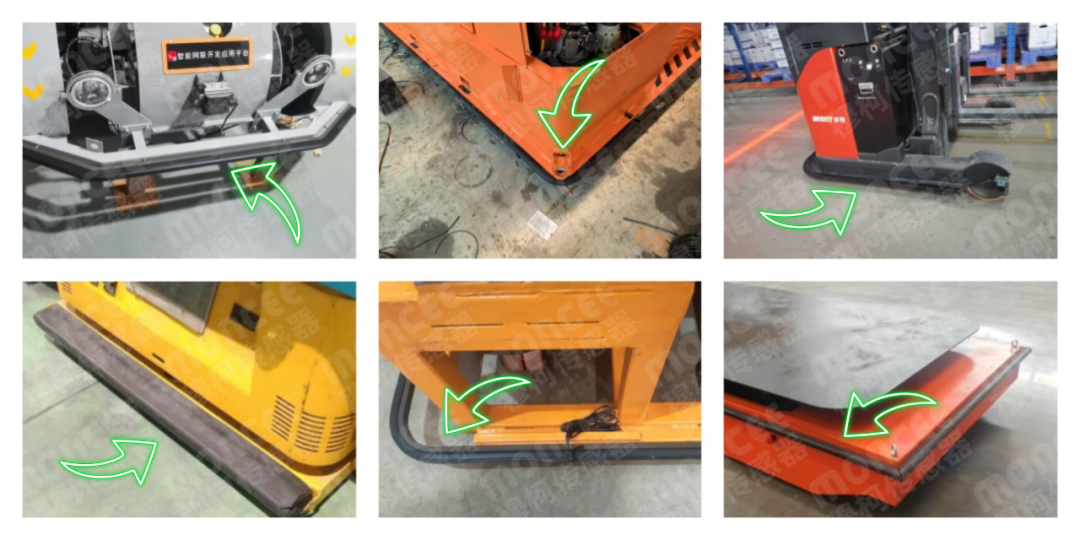
Mounting and preparation: An unsuitable profile or mounting arrangement may require extra brackets, drilling, machining, or modifications to the machine structure. Confirm the installation interface before placing an order.
Wiring and control integration: Labor may be needed to route cables, connect the sensor, configure the control circuit, and test the system. Confirm the output type and electrical requirements early to minimize avoidable rework.
Custom manufacturing: Non-standard lengths, cross-sections, bending profiles, or machining requirements can affect lead time and cost. Customization may be worthwhile when it reduces extensive on-site modification, but it should be evaluated against the actual project requirements.
Downtime and replacement: Replacing a sensor can involve maintenance labor and interruption to production. A product with an appropriate specification and installation plan may offer better long-term value than a lower-priced alternative that creates recurring service work.
Inspection and commissioning: Allow time for checking mounting, wiring, sensor response, and integration with the machine’s control system. The commissioning process should follow the equipment design, manufacturer instructions, and applicable safety requirements.
4. How to Reduce Machine Guarding Edge Sensor Installation Costs
Cost reduction starts before the purchase order is issued. The most effective approach is to remove uncertainty from the specification and installation process.
Provide complete drawings and measurements
Send the supplier the required sensor length, cross-sectional profile, mounting dimensions, cable or connection requirements, and any relevant machine drawings. Clear documentation helps the supplier identify potential fit issues before production.
For customized components, confirm the drawing revision and obtain approval of the final specification. This can reduce misunderstandings and prevent expensive changes after delivery.
Choose the correct profile at the design stage
Avoid selecting a sensor based only on appearance or unit price. Match the profile to the available space, required trigger characteristics, and intended contact conditions.
For NC safety edge models, follow the manufacturer's installation instructions carefully. Moncee's published guidance warns that bending certain NC models can cause false signals or malfunction. Where a curved installation is required, confirm that the specific model is designed for that geometry rather than forcing a straight model into place.
Standardize models across equipment where practical
If multiple machines share the same requirements, standardizing compatible sensor models may simplify purchasing, spare-parts management, and maintenance training. However, standardization should never override differences in trigger requirements, electrical configuration, or installation conditions.
Confirm integration before delivery
Have the machine builder, integrator, or maintenance team verify the control-circuit requirements before ordering. Confirming NO/NC logic, voltage, current limits, wiring, and monitoring needs can help prevent additional components and repeated commissioning work.
Compare complete quotations
Request an itemized quotation that separates the sensor price from customization, accessories, packaging, shipping, lead time, and any other applicable charges. Ask suppliers to clarify what is included and whether technical support is available for installation questions.
This approach gives procurement teams a more reliable basis for comparing offers than unit price alone.
5. How to Evaluate Supplier Value
A competitive supplier should do more than provide a low quotation. Look for clear technical documentation, responsive engineering support, realistic lead times, and the ability to discuss application-specific requirements.
For OEMs and automation integrators, customization capability may be especially useful when standard products do not fit the machine design. Before confirming an order, ask about available profiles, length tolerances, connection options, drawing-based modifications, quality checks, and warranty terms.
Also verify the product's published specifications and the scope of any warranty in writing. Claims about protection ratings, operating conditions, service life, or safety performance should be supported by documentation for the exact model being purchased.
6. Request an Accurate Machine Guarding Edge Sensor Quote
To obtain a relevant quotation, prepare the following information:
Required quantity and sensor length
Profile drawing or cross-sectional dimensions
Required trigger distance and contact-force characteristics
NO or NC output preference and control-system details
Operating temperature and environmental conditions
Mounting arrangement, cable requirements, and any custom processing
Delivery location and target delivery date
Providing these details helps the supplier recommend a suitable configuration and identify potential installation issues early.
Conclusion: Buy for Total Project Value, Not Just Price
The right machine guarding edge sensor balances technical suitability, installation effort, service requirements, and purchase cost. By confirming specifications, supplying accurate drawings, checking electrical compatibility, and comparing complete quotations, industrial buyers can reduce avoidable expenses while selecting a solution appropriate for their equipment.
Moncee offers safety edge products for industrial applications, with model options and customization subject to the specific requirements. Contact the team with your drawings, operating conditions, and project quantity to request a tailored quotation and technical confirmation before purchase.
Important: A safety edge is one component of a machine safety system. Confirm the complete system design, risk assessment, control architecture, and applicable safety requirements with qualified personnel before commissioning.



 English
 简体中文
 Indonesian
 Previous:
 Back to list


