
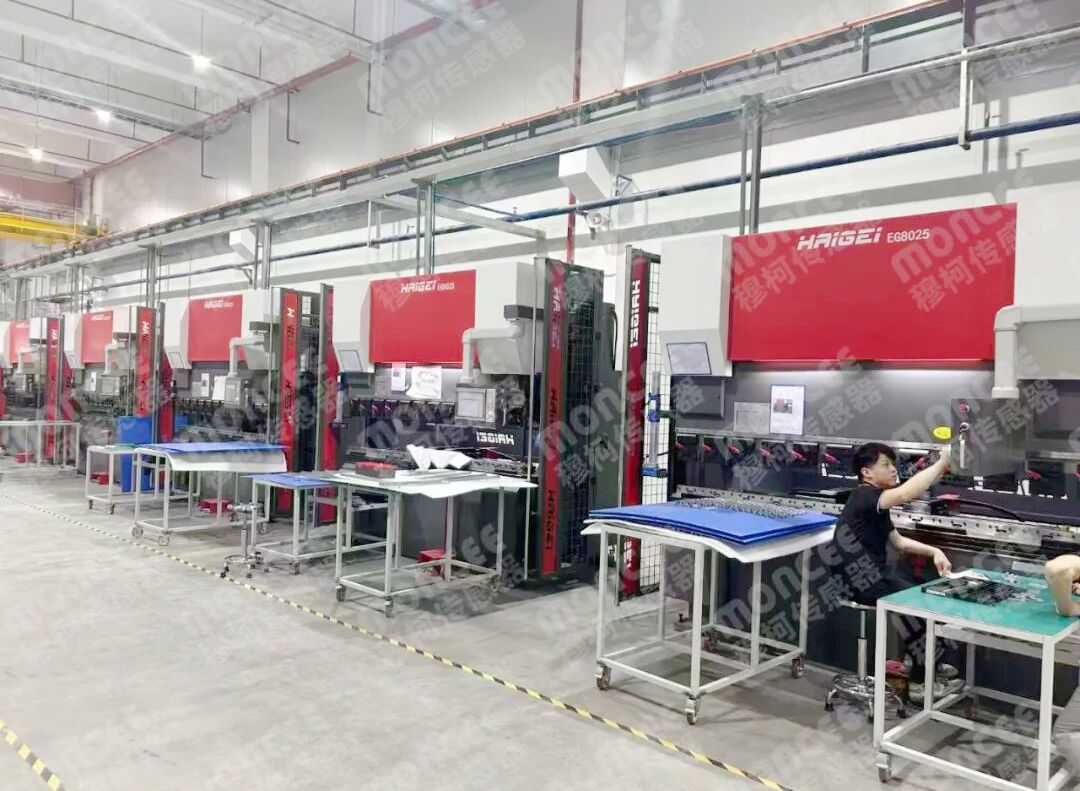
Modern sheet metal workshops typically operate under a model characterized by small batches, high product variety, and frequent tool changes. When considering the installation of laser protection systems on press brakes, factory managers often harbor two primary concerns:
1. Does frequent tool changing require recalibrating the laser every time, thereby slowing down production efficiency?
2. Will laser calibration affect bending precision, leading to defective parts or dimensional errors? These are genuine concerns shared by the vast majority of operators, production supervisors, and business owners.
Drawing on actual workshop operations—and skipping empty technical specifications—we will thoroughly explain the impact of laser protection on efficiency, quality, and the real-world user experience during tool changes.
I. A Key Misconception: Tool Changing Does Not Equal Laser Recalibration
Many assume that installing laser protection means the laser must be aligned and parameters adjusted during every tool change, adding steps and delaying production. This is a major misconception. Whether the laser requires adjustment depends on a single criterion: whether the height and profile of the upper tool tip change.
1. Swapping tools of the same specification and height: No laser adjustment needed
For routine tasks—such as replacing worn-out sharp-nose or radius (R) tools, swapping old tools for new ones, or exchanging tools of identical dimensions—the position of the tool tip remains unchanged. Consequently, neither the laser beam nor the transmitter/receiver heads require modification. Operators simply change and lock the tools, perform a quick functional test, and begin production. The efficiency of the tool change matches that of machines without laser protection, incurring no additional time costs.
2. Changing irregular or height-varying tools: Only simple fine-tuning required
When switching to gooseneck tools, large-radius (R) tools, or irregular tools with significant height differences, the tool tip height or protrusion position changes. This necessitates minor adjustments to the laser protection zone to ensure the beam remains aligned with the tool tip for effective protection. The entire process is quick and simple; a skilled operator can complete the calibration in 2–5 minutes, resulting in minimal impact on overall production capacity.
II. The Truth About Efficiency: Laser Protection Boosts Speed Rather Than Slowing Production
People often focus on the brief time required for occasional fine-tuning while overlooking the overall improvement in production cycle times provided by laser protection. Standard light curtains or unprotected press brakes require a slow descent throughout the entire stroke for safety reasons; this results in time-consuming idle travel and slow cycle times, severely limiting bending productivity. In contrast, laser protection systems support a mode featuring high-speed idle descent followed by a slow approach to the material: the ram descends rapidly in the air and automatically switches to a slow speed as it nears the workpiece. This drastically reduces idle travel time and significantly boosts per-piece bending efficiency.
Simply put: the few minutes spent on fine-tuning during tool changes are easily offset by the productivity gains achieved through high-speed bending throughout the day. In long-term production, laser protection acts as an efficiency-enhancing feature rather than a burden that slows down operations. Newer smart laser systems even support one-touch automatic tool recognition and calibration, virtually eliminating the need for manual laser alignment.
III. The Truth About Quality: Laser Protection Does Not Affect Workpiece Precision or Forming
Many factories worry: Will the laser interfere with the bending process, damage the sheet metal, or cause angle inaccuracies?
The definitive conclusion: When properly calibrated, laser protection has zero negative impact on the bent workpiece.
Laser protection is an independent safety system; it does not participate in controlling bending force, stroke, or angle, nor does it make contact with the workpiece or interfere with mechanical movements. Its function is solely to detect the intrusion of personnel or foreign objects into the work zone and halt the machine immediately if a risk arises. It does not alter bending parameters or cause quality issues such as dimensional deviations, angle errors, or surface scratches.
Occasional machine stoppages due to alarms are not quality issues but rather the result of improper positioning: if the laser is positioned too low, the rising flange during bending may block the beam, causing false stops and production interruptions; if positioned too high, blind spots in protection may occur, creating safety hazards. These issues are easily resolved through proper calibration and have no impact on the workpiece itself.
IV. Summary
Efficiency: For tool changes involving the same specifications, no laser adjustment is required; for irregular tools, fine-tuning takes minimal time. The advantages of high-speed laser bending easily offset the time lost during setup, resulting in an overall increase in production capacity.
Tool Changes: There is no need to recalibrate the laser every time; the process is simple and does not delay production, making it perfectly suited for high-mix, frequent tool-change environments. In terms of quality, the laser system serves solely as a safety safeguard; it does not compromise bending precision, appearance, or forming results, nor does it introduce quality risks. Ultimately, laser protection for press brakes is not a production burden but an essential feature for ensuring safety compliance, stable mass production, and enhanced quality and efficiency. With proper system calibration and effective tooling management, it is entirely possible to achieve both safety and high productivity.



 English
 简体中文
 Indonesian
 Previous:
 Back to list


